Built First Connected Later
The Structural Disconnect in Industrial Development
By Eugene Smith, President at Wire You Networks
America’s manufacturing resurgence is real. Hundreds of billions of dollars in announced investment semiconductors, batteries, advanced manufacturing are reshaping industrial development across the country.
But beneath the headlines sits an infrastructure constraint that rarely makes it into site-selection decks or press releases:
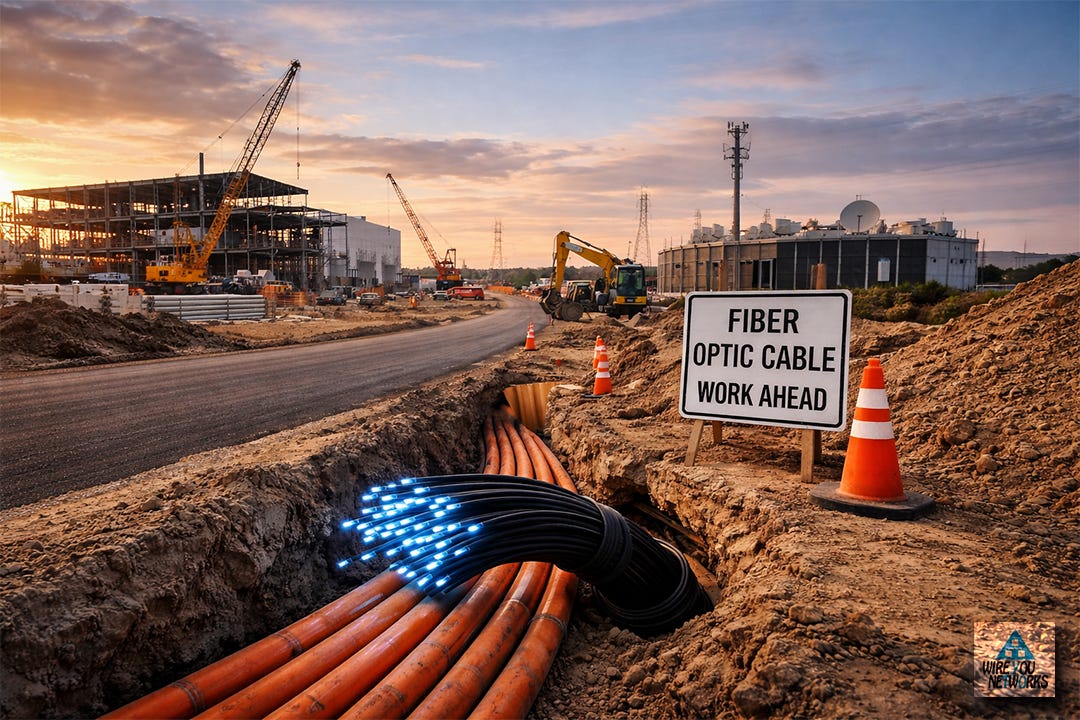
Many of these facilities break ground with no fiber connectivity in place.
Assumption Can Break Timelines
Power can be engineered.
Water can be sourced.
Roads can be expanded.
Fiber is assumed to arrive.
In greenfield and exurban locations, that assumption is often wrong.
Enterprise fiber construction especially underground routinely takes years, not months. Not because the technology is difficult, but because the process is slow: rights-of-way, pole attachments, make-ready work, contractor availability, and coordination across multiple jurisdictions.
By the time operations teams ask when they’ll have diverse, high-capacity connectivity, the answer is often measured in construction seasons.
Why Greenfield Megasites Start at Zero
Modern megasites are selected for:
Large contiguous land
Workforce access
Power and water availability
State and local incentives
They are not selected for telecom readiness.
In many cases there is no existing conduit, no carrier lateral, and no guaranteed path diversity. Every mile must be designed, permitted, and built.
The irony is that the physical plant can rise faster than the network required to operate it.
The Fiber Reality Check
In rural and exurban markets:
Aerial fiber depends on pole access and make-ready timelines.
Underground fiber involves trenching, boring, restoration, and traffic control.
Permitting and labor not materials dominate schedules.
Even sites considered “near-net” frequently require long-lead custom builds.
BEAD Didn’t Eliminate the Bottleneck It Exposed It
The Broadband Equity, Access, and Deployment (BEAD) program, administered by NTIA, is now moving from planning into full-scale deployment.
Federal agencies anticipated permitting friction and spent years streamlining federal review processes, building digital workflows, and exempting many projects from the most time-consuming environmental and historical reviews.
But federal approvals are only part of the path.
State and local permits municipal rights-of-way, pole attachments, utility coordination remain outside that streamlining effort. Even NTIA leadership, including Administrator Arielle Roth, has publicly acknowledged that local permitting capacity may need additional resources as deployment accelerates.
The implication is important:
BEAD increases construction demand faster than it increases local execution capacity.
Manufacturing megasites are now competing with BEAD projects for the same crews, permits, and timelines.
Why This Matters More in 2025–2026
Modern manufacturing is bandwidth-intensive by default:
AI-assisted inspection
Robotics and automation
Digital twins and real-time analytics
Secure interconnection to data centers and cloud platforms
Redundant, diverse network paths
Temporary connectivity can get a site online but it constrains long-term competitiveness and increases operational risk.
The Hidden Costs of Late Fiber Planning
When connectivity is addressed late, manufacturers absorb:
Schedule risk during commissioning
Unexpected CapEx for emergency builds
Limited carrier choice
Weak redundancy and single-path exposure
These costs rarely appear in incentive announcements but they surface quietly in revised timelines and change orders.
A Better Playbook
Fiber needs to be treated like power and water:
Conduit installed during earthwork
Pre-permitted fiber corridors
Carrier-neutral meet-me points on megasites
Coordination between BEAD offices and economic development agencies
Incentives for early carrier commitments
Connectivity is no longer secondary infrastructure.
A Case Study at the Parcel Level
What this looks like in practice becomes clearer at the local level.
A Texas-focused field article examining real industrial parcels and availability checks provides a concrete example of how these dynamics play out on the ground.
(See: “Texas Has Fiber But Where is it?”)
Why Automation Tenants Are Passing on Your Warehouse

By Eugene Smith, President at Wire You Networks